 USA | Dolares | Español

Introducción: Diamantes de Colores
La escala de color de los diamantes incoloros clasifica de la letra D a la Z. Sin embargo, cerca de la zona donde la escala de los incoloros finaliza, comienza la escala de diamantes de color fancy. Los diamantes que se encuentran en el rango X-Y-Z de la escala incolora contienen trazas bien perceptibles de tono amarillo o marrón. Éste es el comienzo de la escala de color Fancy Yellow y Fancy Brown.
Los diamantes Fancy Yellow (también conocidos como diamantes Canary) y los diamantes Fancy Brown (conocidos como diamantes Cognac o Champagne) son los únicos diamantes de color que surgen de la escala de los incoloros.
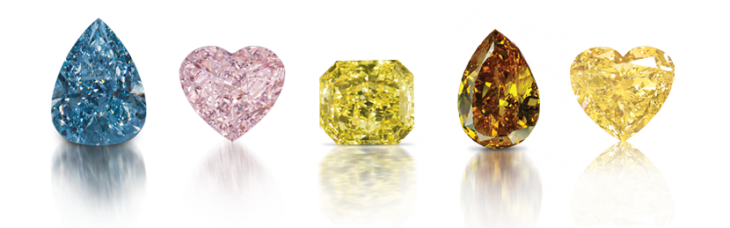
Las primeras 4 piedras de la izquierda son V-X-Y-Z, continuando con Fancy Light Yellow, Fancy Yellow, Fancy Intense Yellow, Fancy Vivid Yellow y Fancy Deep Yellow.
Origen del color:
Los colores únicos en los diamantes son causados por diferentes minerales que pasan a formar parte de los elementos constitutivos de los mismos. Dependiendo del origen de las piedras -de qué lugar son- hay una mayor probabilidad de que ciertos minerales estén presentes y por lo tanto aumenta la probabilidad también de que aparezcan colores específicos.
A diferencia de los diamantes Yellow, en los cuales el color proviene de grandes cantidades de Nitrógeno; o del Blue que es causado por el Boro; o los Violet o Purple por grandes cantidades de Nitrógeno; o los Green que han estado expuestos a radiación atómica o radioactividad; la causa en los diamantes Pink aún es un misterio.
Tipos de Clasificaciones:
Diamantes Tipo I: son los más comunes, representan el 98% de todos los diamantes naturales y contienen rastros detectables de Nitrógeno.
Tipo Ia: contienen grupos de átomos de Nitrógeno en toda la estructura cristalina de la piedra. Tienden a emitir una tonalidad amarillenta.
Tipo Ib: estos diamantes también contienen átomos de Nitrógeno, pero a diferencia de los Tipo Ia, los átomos no están en grupos sino que se presentan aislados. Estas piedras son el 0.1% del total y pueden emitir tonos: amarillo intenso, naranja, marrón e incluso verde.
Tipo IIa: son diamantes muy raros y valiosos, no contienen átomos de Nitrógeno en su estructura cristalina. Las piedras “blancas” de este tipo son excepcionalmente incoloras y las de color Fancy pueden presentarse en Brown, Purple o Pink. Son del 1% al 2% de todos los diamantes.
Tipo IIb: contienen trazos de Boro en su estructura y como resultado a menudo emiten un tono gris o azul. Conforman sólo el 0.1% de todos los diamantes, son piezas muy excepcionales.